


AGIBOT Dynamics
From a Chinese Operating Room to the ERUS Stage: AGIBOT Successfully Performs First Transcontinental Live Surgery
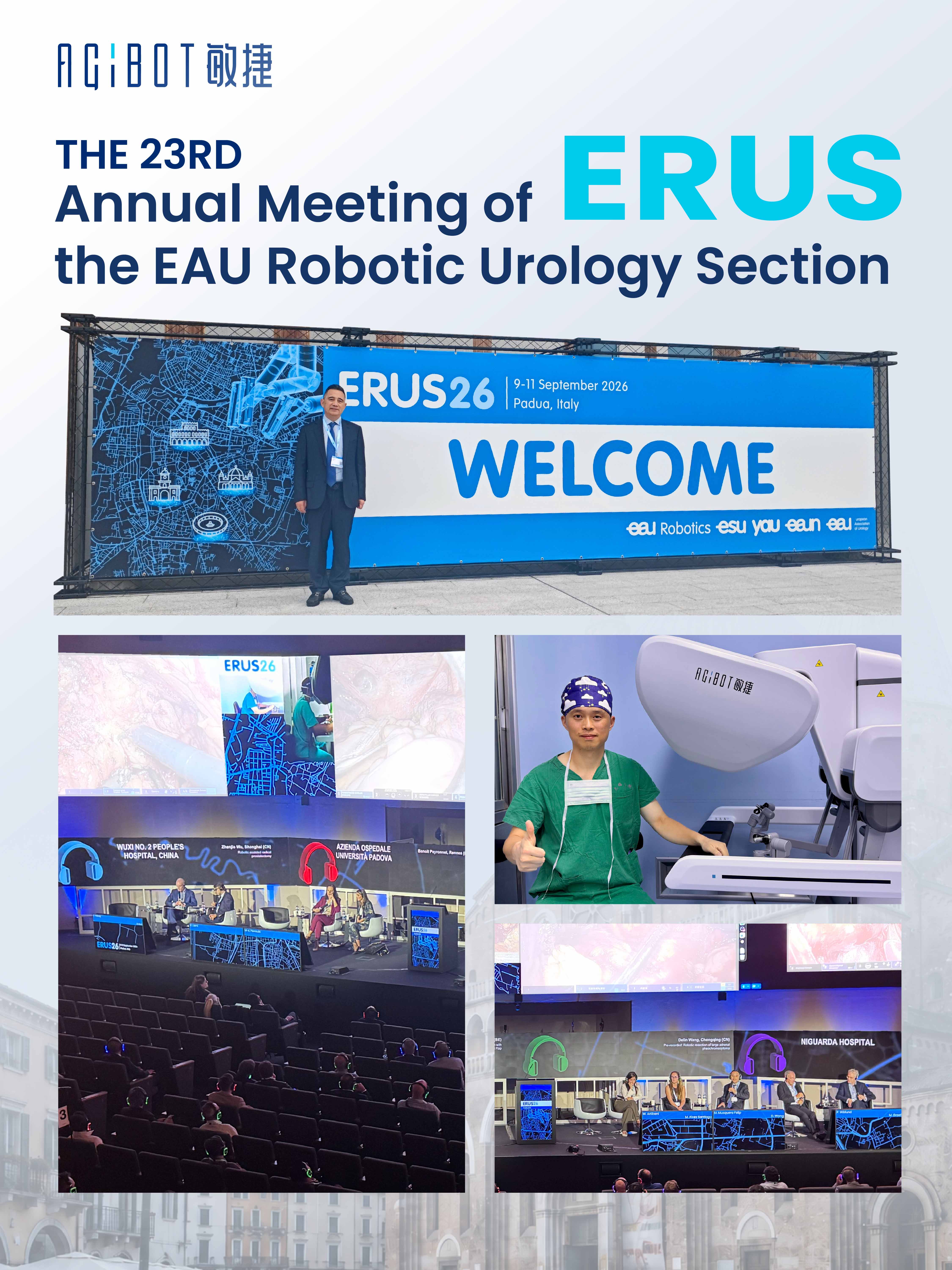
From September 9 to 11, EAU Robotic Urology Section 2026 was held in Padua, Italy. The AGIBOT Endoscopic Surgical System made its debut appearance at ERUS, actively contributing to academic exchanges through a special presentation on complex clinical cases and a live surgical demonstration of Robot-Assisted Radical Prostatectomy (RARP).
On September 10, Prof. Delin Wang from the First Affiliated Hospital of Chongqing Medical University delivered a case report detailing a complex robotic pheochromocytoma resection. On September 11, Prof. Zhenjie Wu from Shanghai Changhai Hospital performed a RARP using the AGIBOT System at Wuxi Second People's Hospital, with the entire procedure broadcast live in real time to the conference hall in Padua.
This marks AGIBOT’s first Live Surgery demonstration at ERUS. Prof. Zhenjie Wu was also the only surgeon from China invited to perform a live surgical broadcast at this year’s congress.
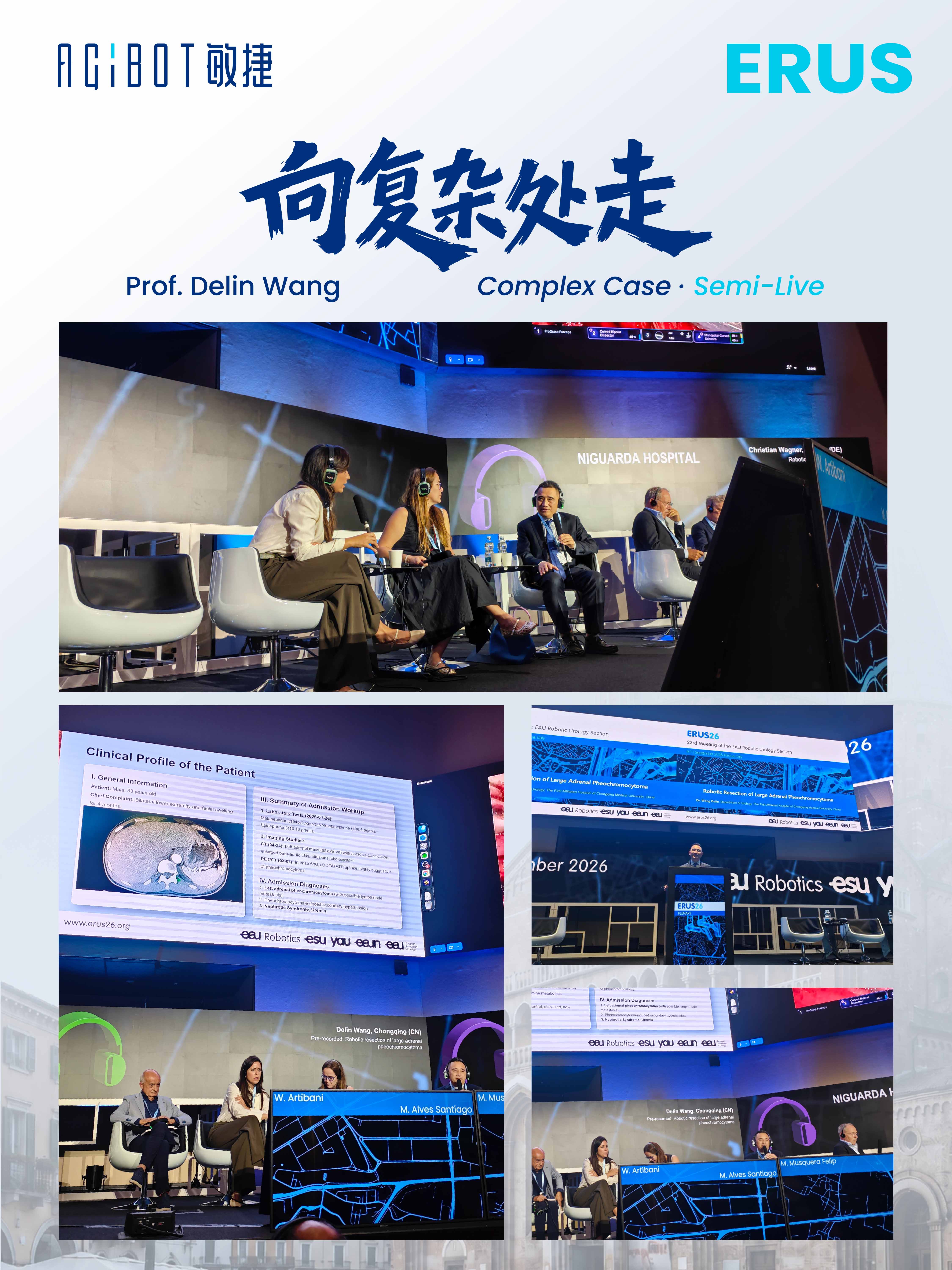
Complex Case: Resection of an 8 cm Pheochromocytoma via Retroperitoneal Approach
On September 10, Prof. Delin Wang presented a case report on a robotic-assisted retroperitoneal left adrenalectomy for a large pheochromocytoma.
The patient, a male in his 50s, presented with a left adrenal mass measuring approximately 90 × 90 mm, characterized by internal necrosis and calcification, alongside co-existing hypertension, nephrotic syndrome, and uremia. Considering the risk of severe intraoperative blood pressure fluctuations associated with pheochromocytoma, the surgical team conducted thorough preoperative preparation and blood pressure management. They selected a retroperitoneal approach and docked the AGIBOT Endoscopic Surgical System to execute the procedure.
Intraoperatively, the surgical team meticulously dissected along natural tissue planes and managed the surrounding vasculature. Dissection of the central adrenal vein represented a critical step, requiring minimal traction and compression of the tumor. Ultimately, the mass and adjacent involved lymph nodes were excised en bloc, with the tumor capsule remaining fully intact.
The operation was completed in 60 minutes, with an estimated blood loss (EBL) of 50 mL. There was no need for blood transfusion, no conversion to open surgery, and zero intraoperative adverse events. The patient was discharged 3 days postoperatively without complications, and postoperative pathology confirmed negative surgical margins.
Following the presentation, the session chairs engaged in a discussion with Prof. Delin Wang regarding perioperative management for high-risk patients and the rationale behind selecting the retroperitoneal approach.
Prof. Delin Wang explained that beyond preoperative alpha-blocker administration, fluid expansion, and blood pressure control, intraoperative success relies heavily on minimizing operative time, executing fine dissection along anatomical planes, and avoiding direct compression or stimulation of the tumor.
Addressing the choice of surgical approach, he noted that while the retroperitoneal space is relatively confined and demands high instrument dexterity and precision, it bypasses the peritoneal cavity, thereby minimizing bowel interference and abdominal visceral disruption. In this case, the AGIBOT system demonstrated exceptional adaptability and precision within the tight operative space.
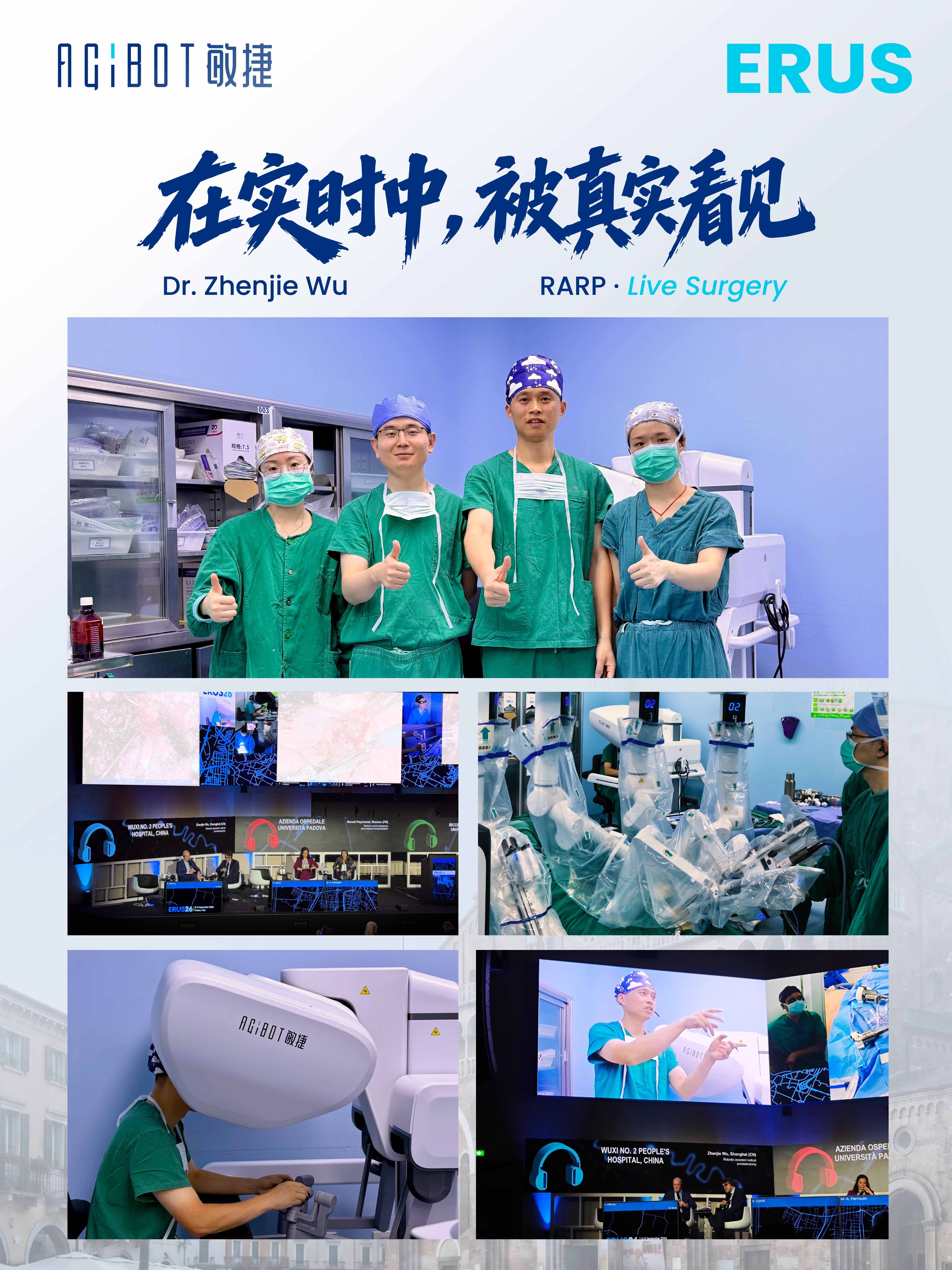
A RARP Live-Streamed from Wuxi to Padua
On September 11, the academic session at ERUS transitioned from case discussions to active live surgery.
The patient, an elderly male, underwent diagnostic evaluation due to persistently elevated Prostate-Specific Antigen (PSA) levels. A prior prostate biopsy indicated benign prostatic hyperplasia (BPH); However, a repeat biopsy confirmed prostate adenocarcinoma with a Gleason score of 3+3=6. Preoperative MRI revealed a nodule in the left transition zone of the prostate, categorized as PI-RADS 3.
At Wuxi Second People's Hospital, Prof. Zhenjie Wu initiated the RARP utilizing the AGIBOT system. Simultaneously, thousands of kilometers away in Padua, Italy, attendees at the ERUS venue watched the live high-definition feed in real time. Precise pelvic dissection, energy application, and vesicourethral anastomosis were broadcast to international experts as the operation progressed seamlessly.
As the procedure advanced into delicate deep pelvic dissection, the intraoperative discussion focused on the real-world performance of robotic systems in such complex procedures.
The deep pelvic cavity presents a narrow working field that requires clear visual depth perception and precise master-slave responsiveness. Drawing from the live case, Prof. Zhenjie Wu highlighted that AGIBOT’s 4K 3D vision system delivers exceptional depth perception, while stable and predictable instrument control is paramount during fine dissection and subsequent reconstruction.
He emphasized that overall system performance throughout a full procedure matters far more than isolated technical parameters. Visual clarity, master-slave control, instrument maneuverability, and foot pedal interactions must harmonize seamlessly in actual surgical tasks. A mature surgical robot should allow clinicians to concentrate entirely on the surgery itself.
When utilizing the bipolar duckbill fenestrated forceps for tissue separation and energy delivery, the dialogue shifted toward surgical instrumentation. Prof. Zhenjie Wu shared that direct contact between energy instruments and tissue yields subtle tactile feedback that surgeons appreciate most in live clinical settings. During the suturing and reconstructive phase, the focus turned to continuous response stability and natural hand-eye coordination during fine suture passes. The session chairs and panel experts in Padua engaged in active, real-time Q&A with Prof. Wu throughout these steps.
Following the final reconstructive steps, the transcontinental Live Surgery from Wuxi to Padua concluded successfully to enthusiastic applause from the audience.
After the procedure, the discussion extended beyond the single case. The session chair raised a broader question: Once a surgical robot is introduced into a hospital, how can sustainable robotic surgical capabilities be established?
Prof. Zhenjie Wu remarked that performing the first case is merely the starting point. Building long-term capability requires structured surgeon training, thoughtful case selection, and expert mentoring. This approach enables surgeons to transition to independent practice and allows institutions to expand from a single surgeon and procedure to multiple specialties and teams. This discussion broadened the exchange from a single RARP to the routine clinical integration of surgical robotics.
From Two Procedures to Broader Clinical Impact
This milestone marked AGIBOT’s inaugural participation at ERUS. From the complex case presentation on September 10 to the transcontinental Live Surgery on September 11, both academic sessions were grounded in solving real-world clinical challenges. Prof. Delin Wang addressed perioperative strategies, surgical approach selection, and precise dissection in complex pheochromocytoma cases, while Prof. Zhenjie Wu demonstrated a complete RARP, facilitating meaningful dialogues on visualization, instrumentation, control dynamics, and the routine clinical adoption of robotic platforms.
In its ERUS debut, AGIBOT brought authentic clinical practice from China to Padua. As AGIBOT expands into increasingly diverse clinical scenarios, it will continue to collaborate with global surgical communities to share insights across varied specialties and robotic surgical applications.
2026.09.14